Owning a pharmacy can be profitable, but revenue alone does not show what the owner earns. The result depends on the pharmacy’s purchasing costs, reimbursement, staffing, overhead, financing and the owner’s role. To assess profitability, distinguish gross profit, operating earnings, owner compensation and cash available after the business meets its obligations.
For an owner considering a sale, the useful question is what the pharmacy’s own records support. This guide focuses on independent community pharmacy economics. Industry observations should not automatically be applied to specialty, infusion, compounding or long-term-care-only businesses with different operating models.
UNDERSTANDING EARNINGS / 01
How do pharmacies make money?
A pharmacy earns revenue from the products and services it provides. Prescription transactions can involve payments from patients and third-party payers. Other revenue may come from front-end merchandise or services the pharmacy actually offers, such as immunizations.
These sources do not necessarily contribute equally to earnings. Review the amount recognized as revenue, the associated purchasing costs and the resources required to deliver the product or service. A larger sales figure does not establish a larger contribution toward payroll and other expenses.
Use consistent definitions when comparing reports. Identify whether a figure describes amounts billed, recognized sales or cash collected, and ask your accountant to explain adjustments. Compare the same periods rather than combining a full-year sales number with a partial-year expense report.
UNDERSTANDING EARNINGS / 02
Revenue, gross profit, net income and owner pay: what is the difference?
Start by naming the figure being discussed. “Profit” can describe different points in the financial statements, while an owner’s bank deposits may include payments with different purposes.
| Figure | Meaning | What it does not establish |
|---|---|---|
| Revenue | Sales recognized for a stated reporting period | Profit or cash already collected |
| Cost of goods sold | The costs classified as goods sold during that period | All cash spent purchasing inventory |
| Gross profit | Revenue minus cost of goods sold | Earnings after payroll and overhead |
| Gross margin | Gross profit divided by revenue, expressed as a percentage | Net profit margin or owner take-home pay |
| Operating profit | Earnings after the operating expenses included in the report | Cash available after every financing and investment need |
| Net income | The bottom-line accounting result after applicable remaining expenses | The amount that can safely be distributed |
| Owner compensation | Payment for the owner’s work, treated according to the business structure | An additional profit amount if already counted in expenses |
| Owner distributions | Cash or other value paid out to owners in their ownership capacity | A substitute measure of operating performance |
Expense classifications matter. Identify how payroll, depreciation, interest and owner compensation appear in the statements before comparing businesses. The SEC’s educational guide distinguishes income statements from cash-flow statements: accounting earnings and movements of cash are related but different. SEC: Financial statement guide
UNDERSTANDING EARNINGS / 03
What does the available evidence say about pharmacy profitability?
NCPA released its 2026 Digest on October 4, 2026. Its public release reports that over 96% of independent-pharmacy sales came from prescription departments in 2025. That describes revenue mix, not an owner’s income. NCPA: 2026 Digest release
A clearly dated comparison appears in NCPA’s November 2025 summary:
| Reported measure per location | 2023 | 2024 |
|---|---|---|
| Average annual sales | $4,997,000 | $5,411,000 |
| Gross profit margin | 19.7% | 18.2% |
The sales figure rose while the gross-margin percentage fell. These are historical report observations, not 2026 results, net margins or salary targets. The public summary does not provide the financial respondent count or averaging details needed for a fuller assessment. Do not multiply separate averages and describe the result as observed average gross profit. NCPA: November 2025 summary, PDF page 6
UNDERSTANDING EARNINGS / 04
A hypothetical example: from pharmacy sales to profit and cash
The following invented example illustrates the calculations for one year. It is not an industry average, client transaction, forecast or recommended margin.
From revenue to accounting profit
Assume accrual-based reporting, with the following expenses classified as shown. The staff-cost line includes a hypothetical $150,000 gross owner wage and its assumed related employer costs within the total. That wage is already an expense; it is not an extra amount of company profit.
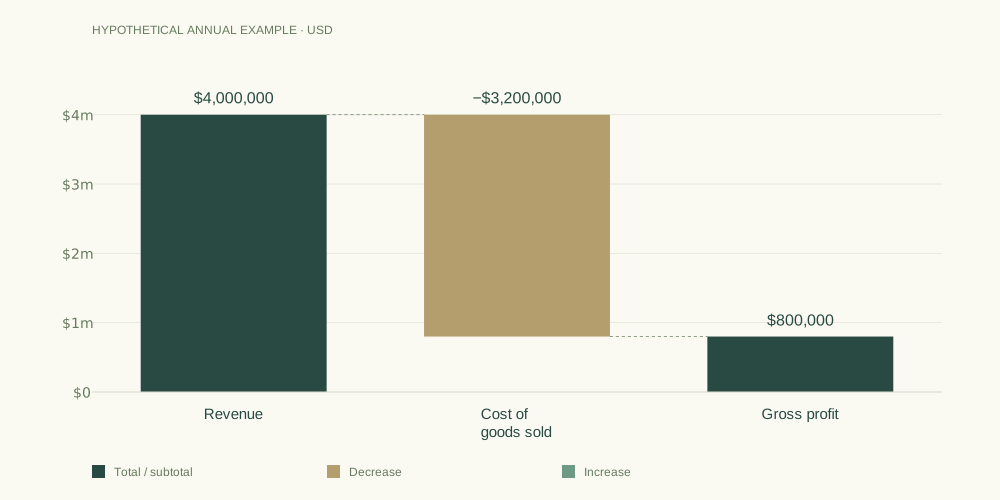
Invented annual example in USD; not an industry average or client result.
On a small screen, scroll across the chart to see every step.
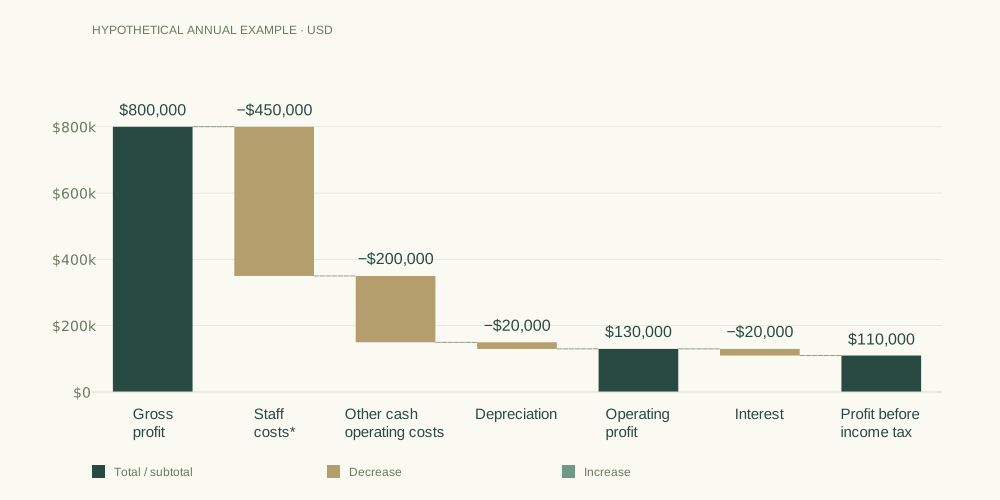
*Staff costs include the hypothetical $150,000 owner wage. Ending figure is before income tax. USD; invented example.
On a small screen, scroll across the chart to see every step.
View the detailed income statement
| Hypothetical annual income statement | Amount |
|---|---|
| Revenue | $4,000,000 |
| Less cost of goods sold | ($3,200,000) |
| Gross profit | $800,000 |
| Less staff costs, including the owner wage | ($450,000) |
| Less other cash operating expenses | ($200,000) |
| Less depreciation | ($20,000) |
| Operating profit | $130,000 |
| Less interest expense | ($20,000) |
| Profit before income tax | $110,000 |
Gross margin is 20%: $800,000 divided by $4,000,000. The $110,000 result is before income tax, not after-tax owner income. Entity-level income tax is assumed to be zero solely for this illustration; an actual business’s tax treatment requires CPA review. Owner personal taxes are outside the example.
From accounting profit to available cash
Now assume the same year includes these cash movements:
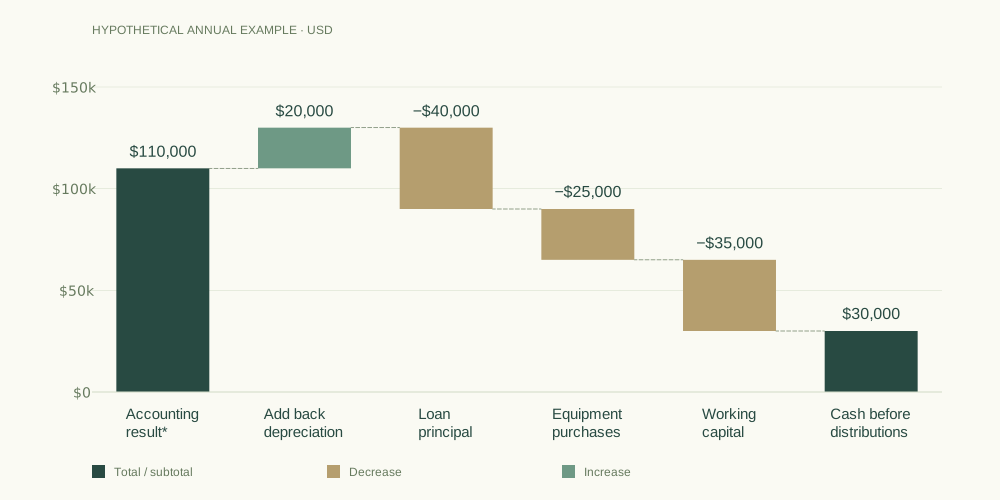
*Entity-level income tax is assumed zero; owner personal taxes excluded. $30,000 is cash movement before distributions, not automatically available for withdrawal. USD; invented example.
On a small screen, scroll across the chart to see every step.
View the detailed cash bridge
| Illustrative cash bridge | Amount |
|---|---|
| Start with the $110,000 accounting result under the stated tax assumption | $110,000 |
| Add back noncash depreciation | $20,000 |
| Subtract loan principal paid | ($40,000) |
| Subtract capital equipment purchases | ($25,000) |
| Subtract the net cash absorbed by operating working capital | ($35,000) |
| Remaining cash movement before owner distributions | $30,000 |
For this simplified bridge, the working-capital line covers inventory, receivables and operating payables. Assume no other noncash adjustments, asset sales, new borrowing, capital contributions or cash movements. Actual statements may require additional reconciliation.
Interest was already deducted in the income statement; it is not deducted again. The owner wage was also already included. The $30,000 is not automatically available for distribution: opening cash, reserves, upcoming commitments and borrowing terms still matter. It is separate from the owner’s wage and personal taxes.
UNDERSTANDING EARNINGS / 05
How much do pharmacy owners make?
There is no single income figure that this evidence establishes for every pharmacy owner. Separate payment for work from the financial return on ownership, then consider ownership share and the business’s cash requirements.
An owner working in the pharmacy may perform professional, management and administrative duties. A buyer needs to understand those duties and the cost of covering them. An owner who works fewer hours may have a different staffing structure; comparing the two businesses requires more than comparing reported profits.
The IRS explains that procedures for paying yourself depend on the business structure. Wages, partnership arrangements and distributions have different considerations. Discuss the treatment with your CPA rather than assuming every payment to an owner is salary or every accounting profit is a distribution. IRS: Paying yourself
Employee pharmacist wage data would not, by itself, establish an owner’s total income. Likewise, a distribution drawn from existing cash does not demonstrate that the current year’s operations earned that amount.
UNDERSTANDING EARNINGS / 06
Why can pharmacy sales grow without improving profit?
More sales help only to the extent they contribute enough after associated costs. A change in prescription or payer mix can change the relationship between sales and purchasing costs. Extra activity may also require additional staffing, equipment or working capital.
Review changes in both dollars and percentages. A lower gross-margin percentage does not by itself prove lower total gross-profit dollars, and a higher gross-profit amount does not prove higher net income.
Compare the same business over consistent periods and identify what changed: revenue mix, purchasing terms, labor, premises costs or other expenses. Avoid attributing every difference to one cause without supporting records. Also evaluate proposed new services on their own costs and requirements; do not assume that adding a service automatically improves profit.
UNDERSTANDING EARNINGS / 07
What should an owner or buyer review in the financial records?
Use a review list that connects reported performance to the underlying business:
- Financial statements and tax returns for consistent periods, with differences explained.
- Current interim results, clearly labeled as partial-year information where applicable.
- Inventory, receivables and payables reports that help explain working-capital needs.
- Revenue and payer information at an appropriate business-summary level.
- Owner duties, compensation and the staffing needed to perform those duties.
- Proposed earnings adjustments with amounts, explanations and supporting records.
A possible adjustment is a review item, not an automatically accepted add-back. Identify what would actually change under a buyer’s ownership and avoid counting the same benefit twice.
Use a pharmacy sale preparation checklist to organize available information and unresolved questions. Agree on a suitable sharing process before providing confidential records.
UNDERSTANDING EARNINGS / 08
How does profitability affect pharmacy valuation and sale readiness?
A valuation discussion should distinguish recorded results from assumptions about future ownership. Consistency, support for proposed adjustments and the responsibilities covered by the owner all deserve attention.
EBITDA and seller’s discretionary earnings, or SDE, are different earnings measures. Their definitions and adjustments must be stated; neither is automatically cash available to an owner. Do not treat an earnings measure as a sale price without a separate assessment.
The pharmacy valuation page can explain that broader discussion. Keep this guide focused on understanding the performance figures behind it.
OWNER QUESTIONS
Pharmacy profitability and owner-income FAQs
What is a good profit margin for an independent pharmacy?
First specify gross margin or net margin, the reporting period and the pharmacy model. Compare consistently defined figures with relevant evidence and your own history. This guide does not establish a universal margin target or a minimum result that makes a pharmacy a suitable acquisition.
Is pharmacy gross profit the same as the owner’s income?
No. Gross profit precedes the operating costs that remain to be paid. Owner compensation may already be included in those costs. Financing, tax and cash requirements also need separate consideration before discussing personal income or distributions.
Is a pharmacy owner’s salary separate from business profit?
Where the owner’s wage is recorded as an expense, profit is calculated after that expense. Other business structures may account for owner payments differently. Confirm the treatment with your CPA and avoid adding compensation twice when reviewing earnings.
Can a pharmacy show a profit but have limited cash?
Yes. Collections, inventory, supplier payments, loan principal and equipment spending can affect cash differently from accounting profit. Review a cash-flow reconciliation alongside the income statement rather than assuming positive profit means all obligations can be paid immediately.
Can an industry average tell me what my pharmacy is worth?
No. An average provides context, not a business-specific valuation. Your records, operating model, transaction scope and relevant buyer considerations need assessment. A published gross-margin percentage is not a valuation multiple.
What records should I gather to understand my pharmacy’s earnings?
Start with financial statements, tax returns, current operating reports and relevant inventory and working-capital schedules. Prepare explanations for differences and proposed adjustments. The guide to preparing your pharmacy for sale provides a fuller starting checklist.
NEXT STEPS
Understand your pharmacy’s figures before deciding what comes next
Is owning a pharmacy profitable in your circumstances? Start with reconciled records and a clear distinction between business earnings, owner pay and cash needs.
If you are considering selling your pharmacy, discuss a possible sale with PharmacyBizBroker.com and identify what information would be appropriate for an initial conversation.
This guide provides general educational information, not a valuation or individualized financial, tax or legal advice. Consult your accountant/CPA and attorney about your circumstances.